The thing that beat virtual reality was not better graphics or a cheaper chip. It was a weight budget, and the fact that nobody wants to look like that in public.
For about a decade the industry treated the headset as a temporary shape. The reasoning went that panels would get denser, silicon would get smaller, optics would fold, and the brick on your forehead would gradually shrink into something you’d wear on the street. That was the story told at every demo booth from 2016 onward, usually while somebody stood there with a strap flattening their hair and a cable running down into a phone.
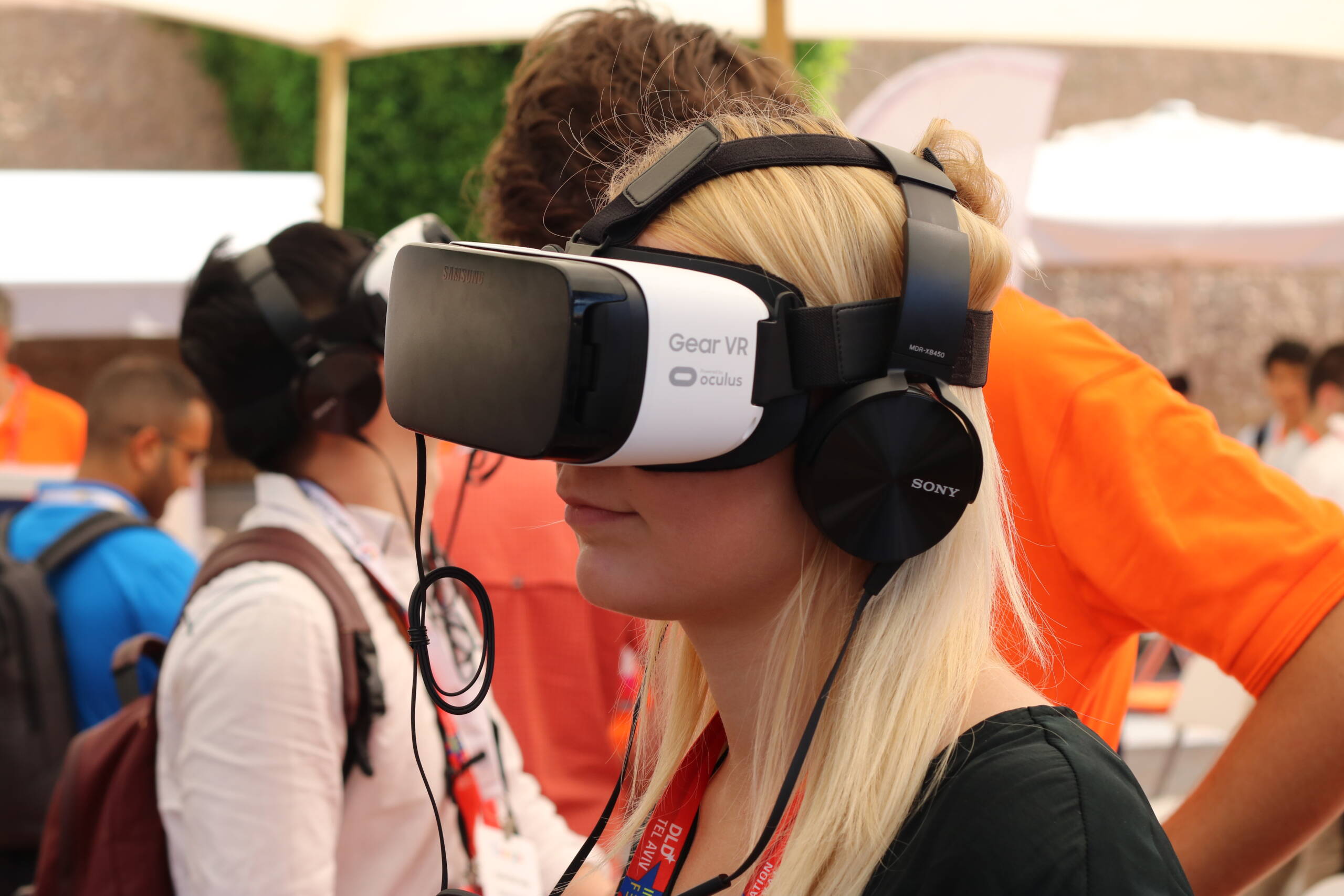
It didn’t shrink. What happened instead is that a different product, built on different assumptions, walked past it.
The weight budget explains almost everything
Current headsets land somewhere between 400 and 600 grams. Current AR and AI glasses land between 30 and 80. That is not an incremental gap you close with a process node. It is the difference between a thing you schedule time for and a thing you forget you’re wearing.
Meta’s Ray-Ban Display is the useful data point here, because Meta has spent more money than anyone on both sides of the question. The Display frames come in at 69 grams, roughly twenty grams heavier than an ordinary pair of Wayfarers. That number is not a spec, it’s a constraint the entire product was designed backwards from. To hit it, Meta rearchitected the display module rather than the frame, built a custom light engine and geometric waveguide, and used ultra-narrow batteries shaped to fit inside a temple arm.
Then it did something more revealing. Rather than add cameras and sensors to the frames for hand tracking, it shipped a separate wrist-worn Neural Band that reads muscle signals in the forearm and turns them into pinches and swipes. Moving the input hardware to the wrist is a hardware decision only in the narrow sense. It is really a statement about where the grams are allowed to go. Every gram added to the temples is a gram people stop wearing after a week.
A headset has no equivalent escape hatch. Passthrough mixed reality needs cameras with baseline separation, it needs displays close to both eyes, it needs the compute to run the whole scene at latency low enough not to make you ill, and it needs a battery large enough to feed all of that. Every one of those requirements pushes mass onto your face. There is no clever repackaging that makes a device with two high-resolution panels, a full sensor stack and an hour-plus battery weigh 70 grams.
The application changed underneath the hardware
The second thing that happened is that the reason to wear a computer on your face stopped being immersion.
Multimodal AI turned out to want almost nothing that a headset provides, and everything that a pair of glasses provides cheaply. It wants a camera pointed where you’re pointed, a microphone near your mouth, and speakers near your ears. It does not need a display at all. You ask what a sign says, or what that plant is, or what somebody just said in a language you don’t speak, and the answer arrives as audio. The whole interaction runs on hardware that fits inside a normal frame with room to spare.
That is why display-less glasses, the ones with a camera and speakers and no screen anywhere, are carrying most of the growth in the category. Counterpoint found AI features in 88% of smart glasses shipped in the second half of 2025. The screen turned out to be optional for the killer app, which is an awkward finding for an industry that spent ten years optimising screens.
Compare that with what a VR headset asks of you. It asks you to stop what you’re doing, clear a space, put it on, and accept that you cannot see the room. It is a destination device. Glasses are an accompaniment device. In practice, people use accompaniment devices thirty times a day and destination devices twice a month, and that ratio is the entire commercial story.
Optics decide what is actually possible
Where glasses do carry a display, the physics forces a much smaller ambition, and that turns out to be a feature.
The Ray-Ban Display puts a 600 by 600 pixel full-colour panel in the right lens only, at a 20-degree field of view, running up to 5,000 nits so it stays readable in sunlight. Most consumer waveguide displays sit in the 30 to 50 degree range, against something like 200 degrees of human peripheral vision. Nobody is building a world in that space. What you get is a notification, a walking direction, a live caption, a viewfinder, a line of translated text.
The remaining hard problem is brightness. Micro-OLED tops out around 1,000 to 3,000 nits, which is fine indoors and marginal against a bright sky, so the industry’s next transition is to microLED, which can push past 10,000. Until that lands at reasonable cost and yield, outdoor legibility stays the ceiling on what these things can show you.
None of that competes with a headset on visual quality, and the makers have stopped pretending it does. The Display is a heads-up layer for a phone you no longer have to take out of your pocket. That is a smaller claim than “the next computing platform,” and it is a claim the hardware can actually deliver on today.
The bottleneck was never capability
You can read the industry’s own conclusion in how it markets the products. At Google I/O 2026, Google and Samsung previewed Android XR audio glasses co-designed with Warby Parker and Gentle Monster, and the headline was that the frames would sit inside those brands’ normal collections. Two of the largest hardware companies on the planet led with the eyewear label instead of the silicon. When that happens, the constraint being solved is social, not technical.
The market is behaving accordingly. RayNeo, spun out of TCL, claims 23.7% of global consumer AR glasses shipments in the first quarter of 2026. Rokid’s display glasses weigh 49 grams and lead the display-AI category globally. XREAL is selling a private cinema screen at $299, which is a price point no headset maker has ever managed with a comparable proposition. Meanwhile Ray-Ban Meta has already proved the awkward part: millions of people will wear a camera and a microphone on their face, provided the camera and microphone are hidden inside something that reads as a normal object.
What VR keeps
Glasses did not win everything. They cannot do presence, which is the one thing a headset does that nothing else does. Sitting inside a place that isn’t there, at scale, with your body’s sense of position agreeing with your eyes, still requires panels close to both eyes and a sealed field of view. Games need that. Simulation and training need that. Design review and remote surgery visualisation need that.
So the two categories are separating permanently rather than converging, which is the opposite of what everyone assumed in 2016. Headsets are becoming specialist equipment, bought for a purpose, justified by a use case, and increasingly sold to institutions rather than teenagers. Glasses are becoming the general-purpose wearable, and they got there by refusing to do the hard version of the job.
The strap-and-cable photograph from a conference tent nine years ago now reads as a picture of a category that guessed wrong about which constraint mattered. It wasn’t the graphics. It was the grams, and the mirror.
Leave a Reply