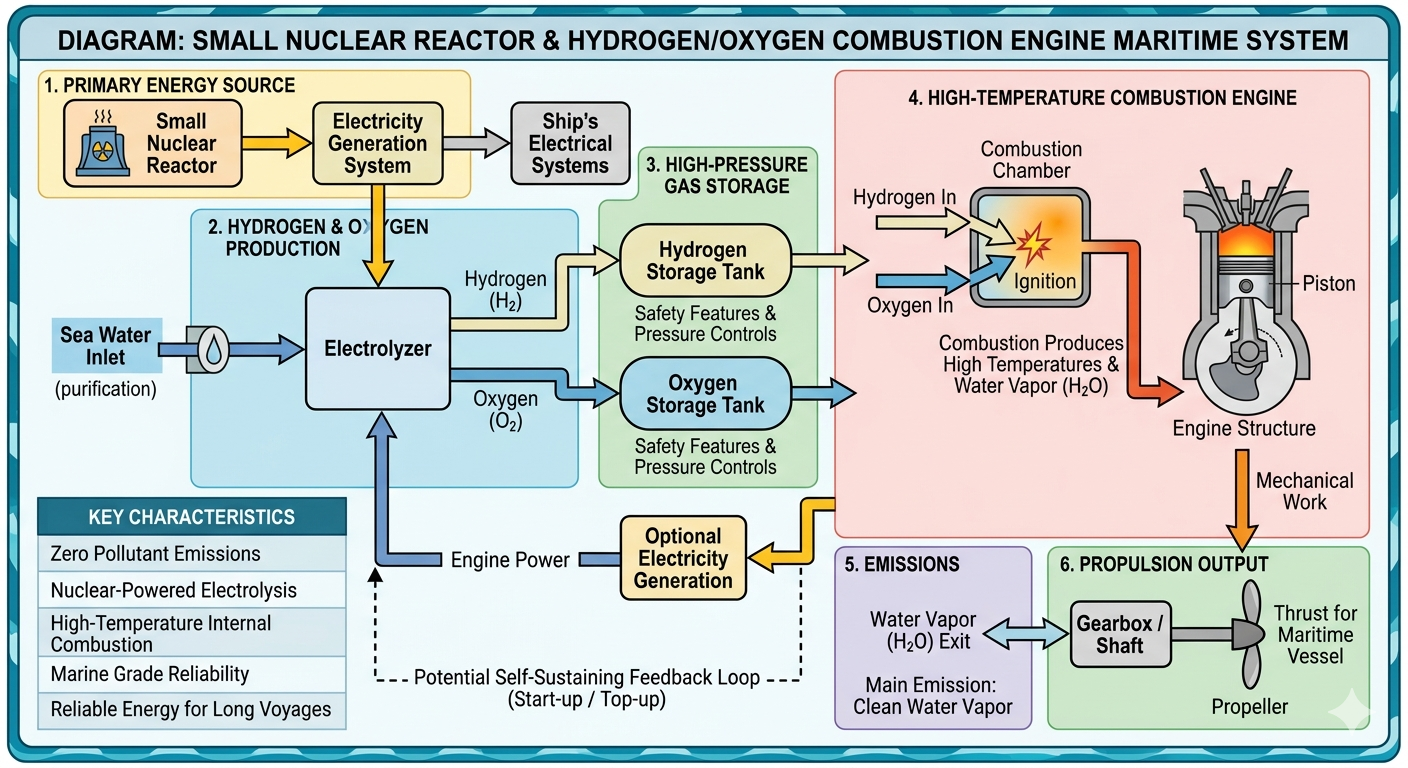
The concept examined here is not a thought experiment at the fringe of engineering. It sits at the intersection of two of the most intensively pursued technologies in maritime decarbonization: small modular reactors and hydrogen combustion. The diagram above illustrates a system architecture in which a shipboard SMR powers an electrolyzer that splits seawater into hydrogen and oxygen, stores both gases under high pressure, and feeds them into a combustion chamber where ignition produces mechanical work — and, as the sole emission, water vapor. The logic is elegant. The engineering barriers remain significant. And the regulatory and commercial momentum building around this class of technology has shifted, in the past eighteen months, from speculative to serious.
The core physics of the system are unchanged. Electrolysis is energy-intensive by nature, requiring a sustained and substantial electrical input to break water’s molecular bonds at the rate needed to sustain ship propulsion. A diesel generator cannot economically fill that role. A small modular reactor — capable of producing between 10 and 300 megawatts of electrical power on a compact, factory-manufactured footprint — can. SMR-powered vessels combine high power density, long endurance, operational speed, and near-zero greenhouse gas emissions in a way that could deliver major efficiency gains and long-term cost stability for deep-sea shipping. The nuclear source is not incidental to the hydrogen-combustion concept; it is the precondition that makes the concept viable at all.
The regulatory environment surrounding this class of vessel is moving. In June 2025, the IMO’s Maritime Safety Committee agreed to begin updating legacy regulations governing nuclear-powered ships, tasking its Sub-Committee on Ship Design and Construction to develop a framework that explicitly goes beyond pressurized water reactor systems to incorporate innovations such as the All-Electric Ship concept. The Nuclear Energy Maritime Organization gained NGO status at the IMO in July 2025, while the International Atomic Energy Agency launched its ATLAS initiative — Atomic Technology Licensed for Applications at Sea — to develop regulatory structures for nuclear propulsion and floating nuclear power facilities. Neither body is engaging with this as a theoretical exercise. Both are responding to a pipeline of real vessel designs seeking approval.
That pipeline has grown substantially. Phase 1 of Norway’s NuProShip project, completed in January 2025, assessed 99 companies developing SMR technologies suitable for ship-based applications and identified three promising reactor designs: Kairos Power’s fluoride high-temperature molten salt reactor, Ultra Safe Nuclear Corporation’s helium-cooled gas reactor, and Blykalla’s lead-cooled reactor. In South Korea, HD Hyundai signed a joint development agreement with the American Bureau of Shipping in March 2026 to advance the conceptual design of nuclear-linked electric propulsion systems for a 16,000-TEU container ship, with the SMR producing up to approximately 100 megawatts of power. Samsung Heavy Industries and the Korea Atomic Energy Research Institute jointly designed an LNG carrier powered by small modular reactors that received initial ABS approval in the second half of 2025. China’s Jiangnan Shipyard has published a design for a 24,000-TEU container ship powered by a thorium-based molten salt reactor, with detailed design and regulatory approvals targeted between 2024 and 2026, sea trials planned for 2029 to 2030, and potential commercial service entry by end of decade.
The economic case is hardening alongside the engineering. A Lloyd’s Register and LucidCatalyst analysis for Seaspan Corporation found that nuclear-powered containerships have the potential to eliminate bunker costs, cut greenhouse gas emissions, and deliver faster transit times, with manufactured nuclear propulsion units potentially reaching commercial readiness within four years of an intensive program at total system costs below $4,000 per kilowatt. Market modelling indicates potential uptake of 40 to 90 gigawatts by 2050, depending on regulatory progress and industry adoption. That range reflects genuine uncertainty — but the floor of the range alone represents a transformation of the global fleet.
On the technology side, critical material milestones are being cleared. Scientists at Idaho National Laboratory successfully synthesized fuel for the Molten Chloride Reactor Experiment, a key step toward the fast reactors envisioned for maritime use by companies such as Core Power. Lloyd’s Register has begun deploying generative AI tools to streamline nuclear approvals, and the American Bureau of Shipping released the first comprehensive rules for floating nuclear power. The regulatory architecture that once represented the longest timeline in this technology’s development is compressing.
The challenges documented in the original framing of this concept remain operative. Hydrogen storage under high pressure aboard a vessel operating in extreme sea states demands material science and containment engineering that continues to evolve. The combustion of pure hydrogen and oxygen in a high-temperature internal combustion chamber subjects engine components to conditions that demand purpose-built alloys and sealing systems. Port access for nuclear-powered vessels requires bilateral or multilateral agreements that do not yet exist in standardized form. Public acceptance, particularly in densely populated coastal regions, is not guaranteed by technical arguments alone. Current nuclear safety rules were built for stationary reactors, while maritime regulations were written for conventional vessels — neither system anticipates mobile nuclear powerplants operating across international waters, approaching ports, or docking near coastal communities.
None of that changes the underlying trajectory. DNV’s latest long-term forecast suggests nuclear propulsion could account for up to 10 percent of the global maritime fuel mix by 2060. With 85 percent of the one billion tonnes of maritime carbon emissions targeted for elimination by 2050 originating from deep-sea vessels above 5 megawatts, nuclear propulsion is one of the few options capable of delivering zero-emission performance at that scale and duration. The SMR-electrolysis-hydrogen combustion architecture diagrammed above represents one specific implementation of that potential — more complex than direct nuclear-electric propulsion, but with the distinctive advantage of a fully closed emissions loop, no reliance on external fuel supply chains, and a theoretically self-sustaining feedback when surplus engine power is recycled to the electrolyzer. The concept is not ready for series production. But the industry surrounding it is no longer treating it as fiction.
Leave a Reply