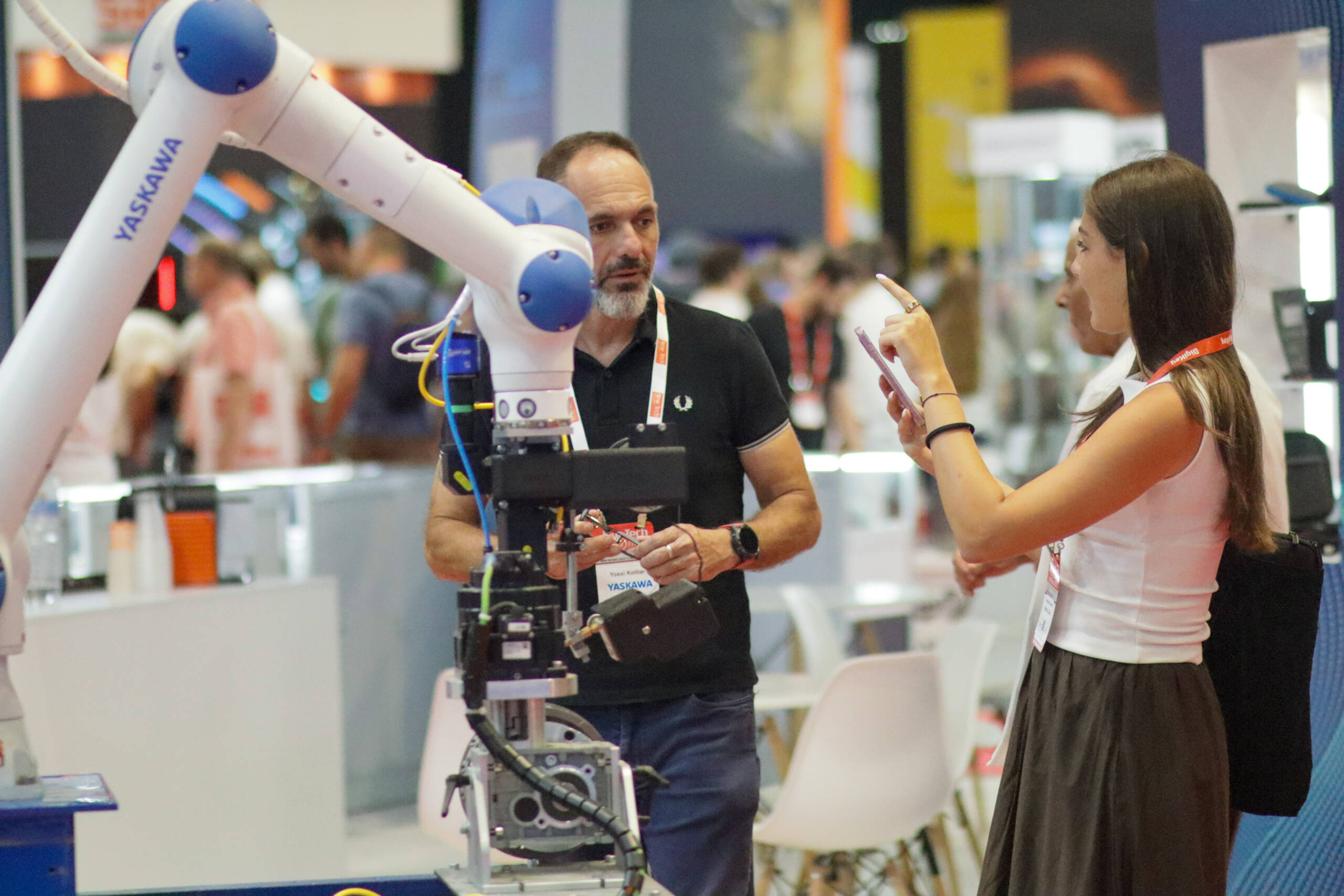
Walk any major tech expo floor this year and the pattern repeats itself: a crowd gathers not around a laptop demo, but around a robot arm. The scene is familiar — a Yaskawa collaborative robot arm, distinctive in its white-and-blue housing, draws a small crowd of attendees while a company representative fields questions from an interested visitor scrolling through specs on her phone.
Cobots Are the New Booth Magnet
Collaborative robots, or “cobots,” have become the centerpiece of industrial tech showcases precisely because they make automation tangible. Unlike a slide deck about machine learning throughput, a robotic arm articulating in real time gives non-technical visitors something they can watch, question, and understand instantly. That accessibility is doing real marketing work for industrial automation vendors trying to ride the broader AI narrative.
Why Yaskawa and Peers Are Positioned for This Moment
Yaskawa Electric, alongside competitors like Fanuc, ABB, and KUKA, has spent the last decade building cobots designed to work safely alongside humans on factory floors — no cages required. What’s changed is the narrative wrapper: these arms are increasingly marketed not just as “robotics” but as physical embodiments of the AI infrastructure boom, paired with vision systems, edge inference, and adaptive control software that lets them handle variable tasks rather than fixed, repetitive motions.
The Real Story Behind the Demo Floor
The AI capex conversation has mostly centered on data centers, GPUs, and hyperscaler spending. But conversations like the one captured here — a vendor engineer explaining torque specs and payload capacity to a curious attendee — are a reminder that the AI boom has a physical, industrial half too. Warehouse automation, precision manufacturing, and quality inspection are all quietly absorbing AI capability, and cobots are the interface where that capital spending becomes visible and touchable.
What to Watch
For technology-watchers, the signal isn’t the robot itself — it’s how quickly software-defined flexibility (the ability to reprogram a cobot for a new task without a specialized integrator) becomes standard. That shift, more than raw arm sales, is what determines whether industrial automation captures a durable share of AI infrastructure spending or remains a hardware footnote to the data center story.
Leave a Reply