• Skip to main content
  • Skip to secondary menu
  • Skip to footer

Technologies.org

Technology Trends: Follow the Money

  • Technology Events 2026-2027
  • Sponsored Post
  • Technology Markets
  • About
    • GDPR
  • Contact

The Open Bridge: Why Vector Databases Need the Model Context Protocol

March 27, 2026 By admin Leave a Comment

In the rapidly shifting landscape of modern artificial intelligence, the connection between vector databases and the Model Context Protocol, or MCP, represents a fundamental shift in how we grant LLMs a “memory” and a “voice.” To understand how they relate, one must first view the vector database as the massive, silent library of an organization’s specialized knowledge. These databases don’t store data in rows and columns like traditional systems; instead, they translate text, images, and documents into high-dimensional mathematical coordinates known as embeddings. This allows an AI to find information based on conceptual similarity rather than exact keyword matches, effectively giving the model a way to “look up” facts it wasn’t originally trained on. However, a library is only useful if there is a standardized way for a researcher to walk through the front door and request a specific book. This is precisely where the Model Context Protocol enters the frame as the universal interface.
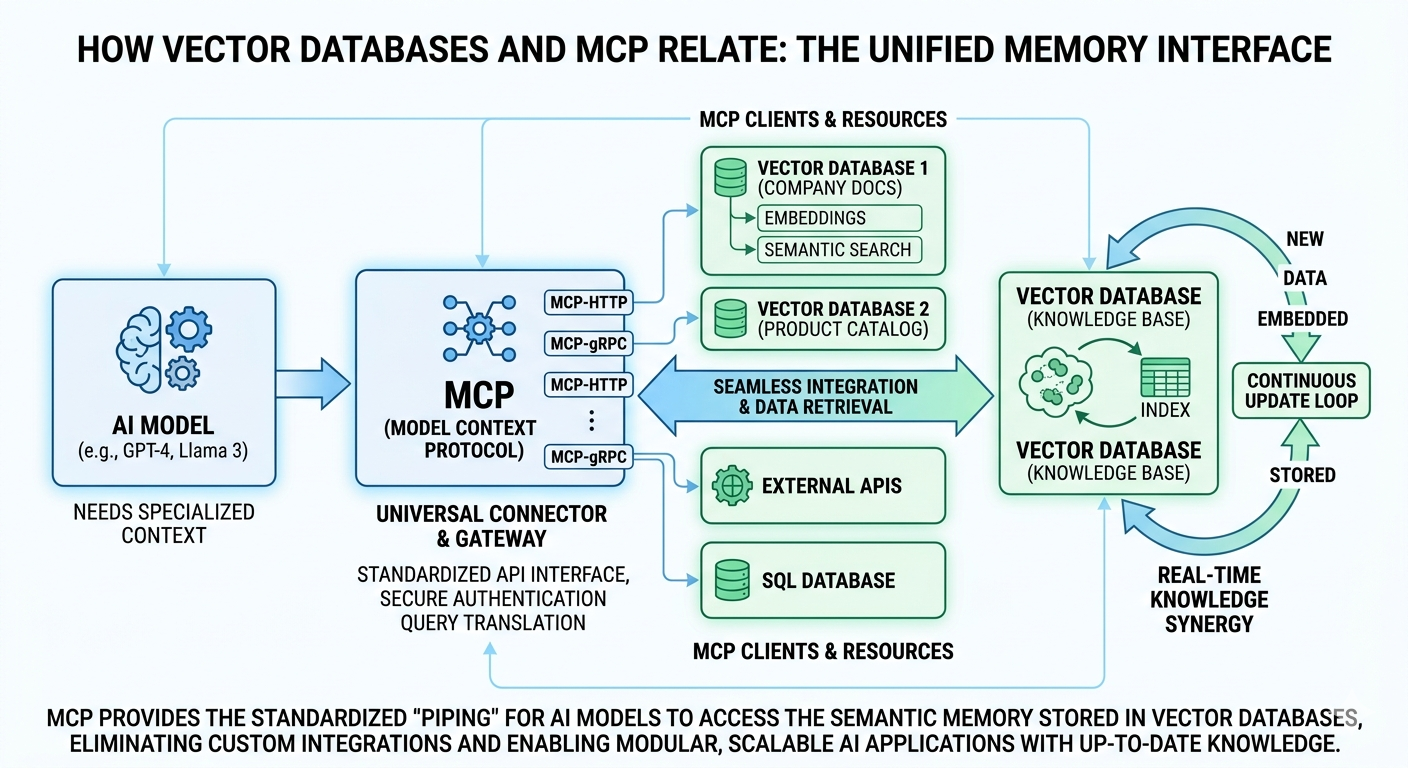
Why Vector Databases Need the Model Context Protocol

The relationship between these two technologies is essentially one of storage meeting delivery. MCP acts as the open-standard bridge that allows AI models to seamlessly plug into various data sources without developers having to write custom, brittle integrations for every single database. When an AI agent needs to answer a complex query using private company data, MCP provides the secure, standardized “piping” that carries the request to the vector database and brings the relevant context back to the model. Without MCP, connecting an LLM to a vector database often requires complex “glue code” that is difficult to maintain; with MCP, the vector database becomes a modular tool that any compliant AI can instantly recognize and utilize.

Furthermore, this synergy solves the “stale knowledge” problem by creating a real-time feedback loop. As a vector database is updated with new documents or live data feeds, MCP ensures that the AI’s retrieval mechanism stays consistent and reliable across different platforms. This means a developer can swap out one vector database provider for another, or move their AI agent from one environment to a different one, and the underlying logic of how the model accesses its specialized context remains unchanged. By pairing the deep, semantic retrieval capabilities of vector databases with the interoperable framework of MCP, we are moving toward a world where AI isn’t just a static brain, but an active participant in a vast, interconnected ecosystem of information.

Filed Under: News

Reader Interactions

Leave a Reply Cancel reply

Your email address will not be published. Required fields are marked *

Footer

Recent Posts

  • How to Actually Use a Raspberry Pi Without Overthinking It
  • Chapter’s $100 Million Bet on AI for Retirement
  • Galaxy A57 5G vs A37 5G Review: Samsung Pushes “Everyday AI” Further Down the Stack
  • Samsung Galaxy A37 5G Review: The Sensible Choice
  • Samsung Galaxy A57 5G Review: The Mid-Range Bar Gets Higher
  • AfterQuery Raises $30M at $300M Valuation as the AI Race Collides with Its Real Constraint
  • Xoople Raises $130M to Build the “System of Record” for the Physical World
  • AI Looms and the Return of American Apparel Manufacturing
  • Manna’s Second Act: From Drone Novelty to Logistics Infrastructure
  • Britain Advances SMR Deployment with £300M Owner’s Engineer Contract

Media Partners

  • Market Analysis
  • Cybersecurity Market
The End of Manual Audits: Why AI-Native Accounting Is Not Optional Anymore
Raspberry Pi’s Earnings Beat Signals a Shift From Hobbyist Hardware to Embedded Infrastructure
Betting the Backbone: A Multi-Year Positioning on AMD, Broadcom, and Nvidia
Nvidia’s Groq 3 LPX: The $20B Bet That Could Define the Inference Era
Why Arm’s New AI Chip Changes the Rules of the Game
A Map Without Hormuz: Rewiring Global Oil Flows Through Fragmented Corridors
RoboForce’s $52 Million Raise Signals That Physical AI Is Moving From Demo Stage to Industrial Scale
The Hormuz Crisis: Winners and Losers in the Global Energy Shock
Zohran Mamdani’s Politics of Confiscation
Beyond Shipyards: Stephen Carmel’s Maritime Warning and the Hard Reality of Rebuilding an Oceanic System
Altum Strategy Group: Cybersecurity in 2026 Is No Longer a Technology Problem
Trent AI and the Security Layer the Agentic Stack Has Been Missing
Gartner Security & Risk Management Summit, June 1–3, 2026, National Harbor, MD
Ashdod Port Has Blocked 134,000 Cyberattacks—and Kept Israel’s Trade Moving
Black Hat Asia 2026, April 23–24, Singapore
World Backup Day 2026: Why Recovery Has Become the Real Test of Cyber Resilience
Cyberhaven Launches Agentic AI Security as Shadow Agents Move Onto the Enterprise Endpoint
Palo Alto Networks Rewrites Security for the Agentic AI Era
RSAC Conference 2026, March 23–26, San Francisco
AI-Speed Warfare Comes to Cybersecurity: Booz Allen’s Vellox Suite Signals a Structural Shift

Media Partners

  • Market Research Media
  • Technology Conferences
Canva Acquires Simtheory and Ortto to Build End-to-End Work Platform
Netflix Price Hikes, The Economics of Dominance in a Saturated Streaming Market
America’s Brands Keep Winning Even as America Itself Slips
Kioxia’s Storage Gambit: Flash Steps Into the AI Memory Hierarchy
Mamdani Strangling New York
The Rise of Faceless Creators: Picsart Launches Persona and Storyline for AI Character-Driven Content
Apple TV Arrives on The Roku Channel, Expanding the Streaming Platform Wars
Why Attraction-Grabbing Stations Win at Tech Events
Why Nvidia Let Go of Arm, and Why It Matters Now
When the Market Wants a Story, Not Numbers: Rethinking AMD’s Q4 Selloff
Accelerate 2026, May 21–22, 2026, Salt Palace Convention Center
JSNation 2026, June 11 & June 15, Amsterdam and Remote
ICMC 2026, July 30–31, Long Beach
Elevate 2026, April 22–24, 2026, Atlanta
WWDC 2026, June 8–12, Cupertino & Online
Zip Forward Europe 2026, April 16, 2026, London
AI Summit: Operationalizing Intelligence and Driving Innovation, April 16, 2026, Woburn, Massachusetts
GTC 2026, March 16–19, San Jose
Taiwan’s AI Ecosystem Steps Into the Spotlight at NVIDIA GTC, March 16–19, 2026
COMPUTEX 2026, June 2–5, Taipei

Copyright © 2022 Technologies.org

Media Partners: Market Analysis & Market Research and Exclusive Domains, Photography