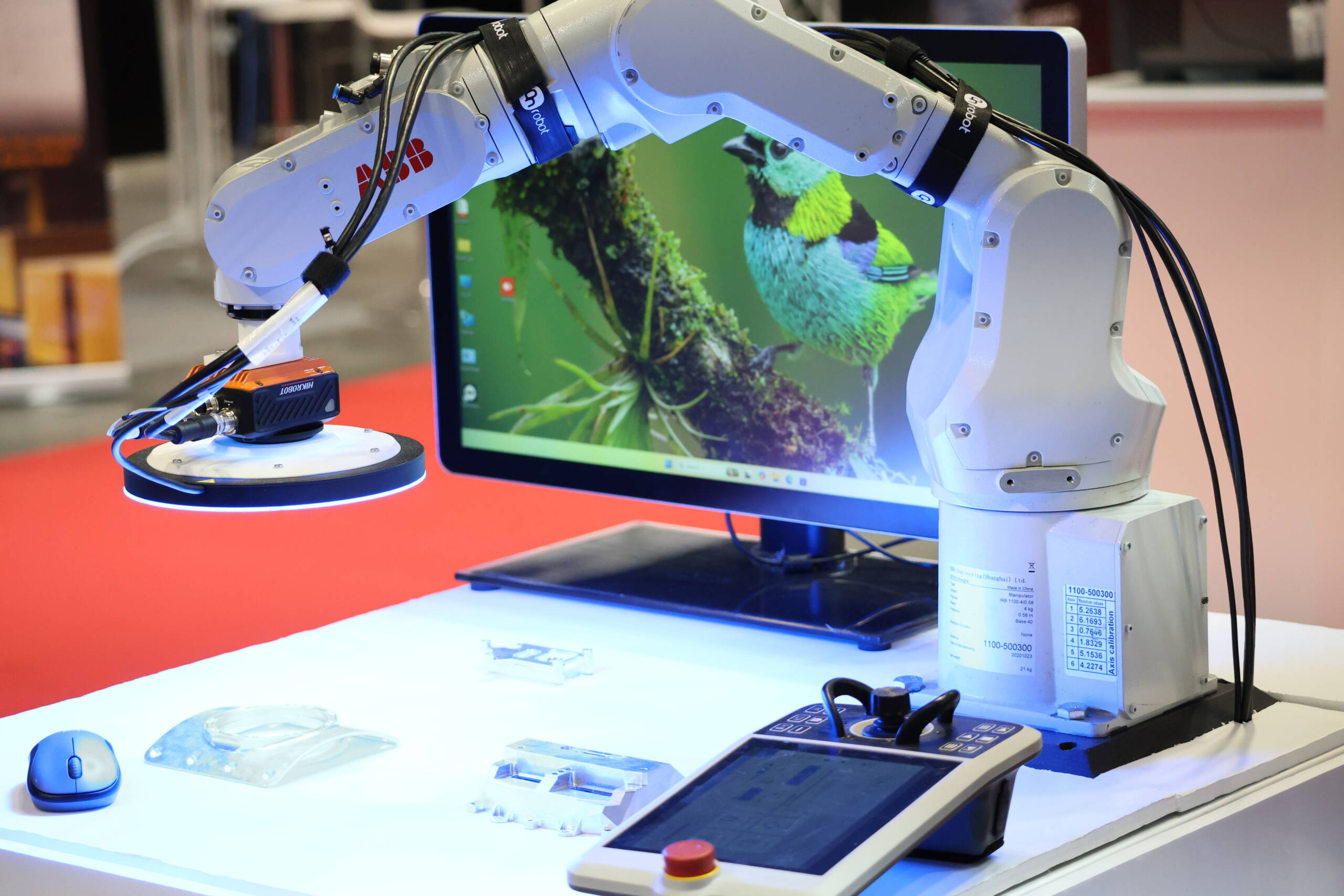
An ABB IRB 1100 six-axis arm sits bolted to a demo table, a HikRobot area-scan camera clamped where a gripper would normally go, its ring light glowing pale blue. Behind it, a monitor is filled edge to edge with a green-headed tanager perched on a moss-covered branch — plumage in five distinct greens, a jet-black hood, a beak sharp enough to count pixels on. Next to the arm: a teach pendant, an emergency stop button, a scatter of clear acrylic calibration jigs. Nothing here is being assembled. The robot is looking at a bird.
This is the part of machine vision demos nobody explains well, and it’s worth explaining, because it’s the whole ballgame.
The parts on the table are the easy problem. Those acrylic brackets and machined aluminum blocks have hard edges, known dimensions, predictable reflectivity. A vision system can localize them with basic edge detection and a bit of thresholding — the kind of task solved reliably since the early 2000s. If that’s all a system ever had to do, nobody would need a dedicated imaging company, let alone a camera engineered specifically for industrial capture.
The bird on the screen is the actual benchmark. Natural imagery is what breaks naive systems. There’s no hard edge between the tanager’s shoulder-green and the moss-green behind it — just a gradient a human eye resolves instantly and a poorly-tuned camera blurs into one blob. The feather structure creates specular highlights that shift with a few degrees of angle. The black hood swallows detail in shadow the way a dark industrial part swallows detail in a poorly lit cell. If a vision pipeline can segment this image cleanly — separate bird from branch from background, hold color fidelity across five adjacent hues, keep edges crisp where the animal’s own texture argues against it — then sorting matte gray brackets on a white backdrop is trivial by comparison.
That’s most likely all this shot is: a demo booth, running whatever high-contrast, high-detail image was loaded up to show attendees the camera’s dynamic range and color separation before it ever picks up a part. It’s a stress test wearing the disguise of a screensaver.
Why the arm matters as much as the camera. The ABB IRB 1100 is a compact, repeatable positioner — rated for sub-0.02mm repeatability in its class — which means once the vision system tells it where something is, the arm’s job is just to not screw that up. The interesting error budget in a pick-and-place cell almost never lives in the motion controller anymore. It lives upstream, in whether the camera correctly told the arm where the object’s true center and orientation are. Put a hard target in front of a so-so camera and the arm will confidently, repeatably grab the wrong spot.
The quiet subplot: calibration data taped to the base. Visible on the robot’s forearm is a printed axis calibration sheet — resolver values for all six joints, dated and serial-numbered. It’s the kind of unglamorous documentation that never makes it into a product photo on purpose, but it’s the difference between a robot that trusts its own proprioception and one that has to re-home every time someone bumps the cell. Vision systems get the marketing attention; joint calibration is what keeps the whole stack honest underneath it.
Put together, the booth is a small, accidental thesis: precision manufacturing hardware is only as good as the perception feeding it, and the way you prove perception works isn’t by showing it a machined part. It’s by showing it a bird.